
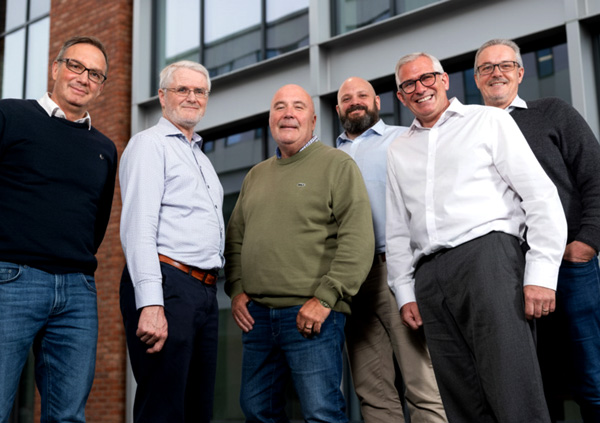
(From left to right:) Stuart Power (Director and Joint CEO), Steven Cooper (Director), Paul Meadows (Trust Director and Joint CEO), James Emery (Director), James Tutton (Director) and Andrew Wignall (Director).
For more than two decades, Salus has grown in a way that is deliberate rather than rushed. Not driven by volume, nor shaped by external pressure, but built carefully around technical competence, professional judgement and trust.
The decision to transition Salus (Building Control & Fire Safety Consultants) Ltd into an Employee Ownership Trust (EOT) follows that same logic.
It is not a departure from how the business has always worked. It is a formal recognition of it.
A business built on people, not just process
Salus was founded over 23 years ago by Paul Meadows, Stuart Power and Paul Morris, all of whom brought with them deep practical experience of the built environment and regulation. From the outset, the focus was clear: do the work properly, take responsibility for decisions, and build long-term relationships based on trust.
As Paul explains:
“We never set out to build something that would be sold on. We wanted to build a business that people could rely on — including the people who work here.”
That philosophy shaped everything that followed. Growth happened steadily. New services were added because clients needed them, not because the market suggested they should be. Leadership developed from within. Technical standards were protected, even when that meant turning work away.
Over time, Salus became a national Registered Building Control Approver and specialist building regulation and fire safety consultancy — but it remained, at its core, a people-led organisation.
The question of the future
Like many founder-led consultancies, Salus eventually reached a natural point of reflection: how do you protect what you’ve built when the original founders are no longer at the centre of it?
For Stuart, that question was less about exit and more about responsibility.
“When you’ve built something over this length of time, you have a duty to think about what happens next,” he said. “Not just for us, but for the people who’ve helped build the business and the clients who rely on it.”
Selling to an external buyer was considered — and ultimately rejected.
“We didn’t want Salus becoming something else because of external pressures,” Stuart explained. “We wanted it to stay Salus.”
Why employee ownership made sense
The Employee Ownership Trust model offered a structure that aligned with how Salus already operated day to day.
Rather than concentrating value or control in the hands of a few individuals, employee ownership places the long-term interests of the business with the people who deliver its work.
“This wasn’t about a financial transaction,” Paul said. “It was about continuity — and recognising that the people here already act like owners in the way they approach their work.”
Under the EOT structure, Salus remains independent. Decisions are made for the long term. The focus stays on competence, professional judgement and doing the right thing — even when that isn’t the easiest option.
From a client and regulator perspective, that independence matters.
“We operate in highly regulated environments,” Stuart noted. “Clients and regulators need to trust that decisions are being made for the right reasons, not because someone is chasing short-term return.”
Continuity, not disruption
As part of the transition, Paul Meadows and Stuart Power remain as Joint Chief Executive Officers, ensuring stability and continuity for both staff and clients.
“We didn’t want this to feel like a handover that creates uncertainty,” Paul said. “It’s very much business as usual — just with a structure that better reflects who we are.”
At the same time, Salus has strengthened its leadership team with the appointment of Steven Cooper, James Emery, James Tutton and Andrew Wignall as Directors — individuals who have grown with the business and understand its culture, standards and responsibilities.
The company also marks the retirement of founding shareholder Paul Morris, whose contribution was instrumental in establishing Salus and shaping its early direction.
“Paul was there at the beginning,” Stuart said. “His influence is still felt across the business.”
What this means for people at Salus
For employees, the move to employee ownership is not symbolic. It creates a direct, meaningful connection between individual contribution and collective success.
“People here already take responsibility,” Paul said. “Employee ownership acknowledges that and gives it a proper structure.”
It also reinforces something Salus has long believed: that expertise develops over time, and that investing in people is not a cost but a foundation.
From apprentices and administrators through to surveyors, consultants and directors, Salus has consistently promoted from within and supported professional development.
The EOT structure strengthens that commitment by anchoring the future of the business to its people.
A structure designed to last
Employee ownership is not a trend for Salus. It is a long-term decision that reflects how the business sees its role within the industry.
“This is about building something that lasts,” Stuart said. “For our people, for our clients, and for the standards we believe in.”
Salus will continue to operate as it always has — delivering building control and fire safety consultancy with clarity, integrity and technical rigour.
The difference is that the future of the business is now formally shared by the people who know it best.
As Paul put it:
“Salus has always been about doing the job properly. Employee ownership helps make sure it stays that way.”
Paul Meadows and Stuart Power are Joint Chief Executive Officers of Salus (Building Control & Fire Safety Consultants) Ltd. As founding directors, they have over 20 years’ experience delivering regulated building control and fire safety consultancy and recently led the organisation’s transition to employee ownership.