
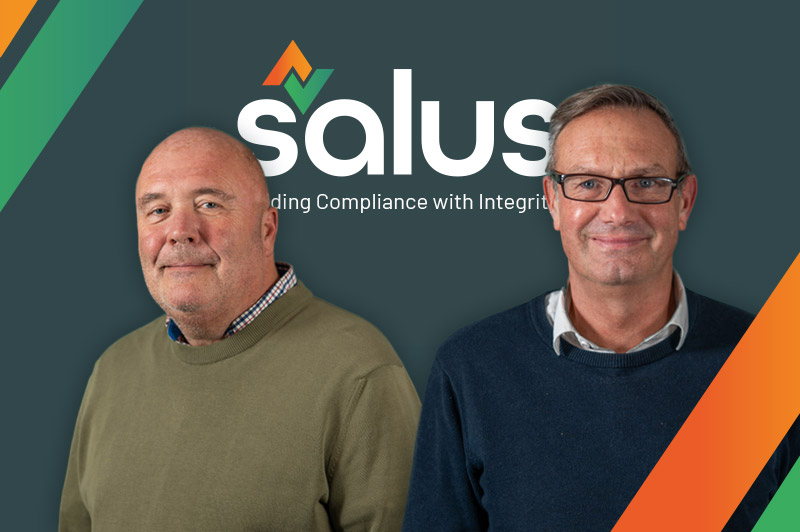
Paul Meadows and Stuart Power on ownership, independence and the future of Salus
For Paul Meadows and Stuart Power, employee ownership was not a sudden decision or a reaction to market pressure. It was the natural outcome of a business built deliberately, patiently, and with a strong sense of responsibility to the people who make it work.
After more than two decades leading Salus, the move to an Employee Ownership Trust (EOT) represents not a step away, but a step deeper into the values that shaped the company from the start: independence, integrity, and long-term thinking.
What follows is a conversation about how Salus came to be, why ownership matters, and what the future looks like when a business is built to outlast its founders.
“We didn’t set out to build something to sell”
Salus was founded in 2002, at a time when private building control was still finding its feet. For the founders, the decision to set up on their own was driven as much by control over their working lives as by opportunity.
Stuart describes falling into building control “by mistake”, starting his career in local authority and discovering a profession that combined technical rigour with real human interaction.
“I never had a specific aim to work in building control,” he says. “I sort of fell into it, like a lot of people do. But I realised it was actually a good profession to be in. You’ve got that mix of being on site and being in the office. It’s interesting work.”
Paul’s route was more direct. Coming from a construction background, he was influenced early on by a simple philosophy.
“My grandfather was a bricklayer and he always said, if you get yourself a trade, you’ll never be out of work,” Paul explains. “I’ve never had a day unemployed in my life.”
After working together at Butler & Young, the three original founders saw a chance to do things differently.
“It was probably a selfish reason at first,” Stuart admits. “We wanted to take back some control of our own lives. We were working incredibly hard, travelling a lot, and there was a lot of uncertainty. So we thought, let’s see if we can do something on our own.”
From the outset, Salus was not built to be flipped or absorbed.
“If we’d sold the business,” Stuart says, “the Salus name would disappear. We’d be swallowed up. That never sat right with us.”
A sector under pressure — and why independence matters
Over the years, the building control landscape has changed dramatically. Consolidation, private equity ownership, and cross-selling models have become common. Paul and Stuart chose a different path.
“A lot of the big organisations talk about compliance,” Paul says, “but it’s compliance of lots of things. Testing, sampling, health and safety — all bundled together.”
Salus resisted that model.
“We specialise in building control and fire safety,” Stuart says. “That’s what we’re good at. We don’t want to do air testing, sound testing, concrete testing. There are other companies that do that well. That’s not us.”
That focus, they believe, has become more valuable — not less — in a post-Grenfell regulatory environment.
“Clients are far more aware now,” Paul says. “They don’t want cheap. They want to know they’re getting good regulatory advice. They don’t want to be the name attached to something going wrong.”
Why employee ownership — and why now?
The conversation about employee ownership didn’t start as a grand strategy. It started with a simple, practical question: what happens next?
“We’d been thinking for years that we needed some kind of exit plan,” Stuart explains. “We were getting older. We’d had approaches to buy the business. We explored them.”
But selling didn’t align with how Salus had been built — or who it was built for.
“We’ve got good staff who’ve worked hard and been with us a long time,” Stuart says. “Why would we sell out and potentially destroy their working lives? That didn’t sit with us at all.”
After revisiting the idea of an Employee Ownership Trust, the fit became clear.
“This actually fits really nicely with the ethos of Salus,” Stuart says. “It protects the legacy. It protects the name. It protects the people.”
Paul is clear that the EOT is not about employees buying shares or taking on risk.
“The employees don’t have to pay to buy the company,” he says. “They’re stakeholders. They’re rewarded for their contribution. That’s the difference.”
“You’re not a number here”
For both founders, one of the strongest arguments for employee ownership is what it signals to current and future staff.
“You’re not just a number on a payroll,” Paul says. “You’re a stakeholder. Your voice is still heard.”
Stuart contrasts this with much of the current market.
“A lot of the large building control organisations are owned by overseas corporations,” he says. “The profits go to shareholders. In an EOT, you’ve got a direct influence. You’re working for a British, independent company, and that matters to a lot of people.”
They believe this will become increasingly important in attracting people who care about the profession itself.
“If you’re passionate about building control,” Paul says, “this gives you a reason to choose Salus over somewhere bigger, but more corporate.”
Leadership after ownership
Employee ownership does not mean the absence of leadership. In fact, Paul and Stuart see it as requiring stronger, more intentional leadership.
Paul has stepped back from the main board and now sees his role as mentor.
“My responsibility now is about supporting the next generation of directors,” he explains. “Helping them move from managing teams to leading an organisation.”
Stuart agrees.
“We’ve made plenty of mistakes over the years,” he says. “That experience is valuable. The key now is passing that on.”
Under the EOT, progression is no longer capped.
“Before, you could only go so far,” Paul says. “Now, you can go as far as you like.”
What success looks like
When asked what success looks like in five or ten years’ time, neither founder talks about exits or valuations.
“Success is the Salus name being stronger than it is now,” Paul says. “Showing that you can evolve and come out better.”
For Stuart, it comes back to people.
“Retention of staff is everything,” he says. “That’s why we’ve done this. If people stay, if they grow, if they’re proud of where they work — that’s success.”
Profitability matters too, but for a reason.
“If the business does well,” Stuart adds, “we can pay people properly. That supports retention. It’s all connected.”
A business built to outlast its founders
Perhaps the clearest statement comes when Paul compares employee ownership with selling.
“Selling would have been destabilising,” he says. “This is the opposite. This is about strengthening the business for the long term.”
Salus’s transition to an Employee Ownership Trust is not a reinvention. It is a formal recognition of what has always been true: the company works because of its people, and its future depends on putting them first.
As Stuart puts it simply:
“We’re not walking away. We’re building for what comes next.”